Civil registry records
Birth, death, marriage and divorce certificates.
English and Spanish
I am Ana Esparza, a certified public translator of English (a sworn translator registered under Argentine law). I translate, sign and seal the documents you need to submit to government bodies, courts, universities and companies, in Argentina and abroad.

English and Spanish in both directions, with no middlemen.
It is the billing unit: one page equals 500 words of the source document.
A certified translation is valid throughout Argentina.
Fees follow the Association's current minimum recommended schedule.
The starting point
They are the only professional authorised by law to translate a document written in a foreign language when that translation has to be submitted to a government body, a court, a university or any institution requiring official backing.
In Argentina the profession is governed by Act 20,305. A certified public translator holds a university degree, is registered with a professional association and is accountable for what they sign: it is their signature and seal that give the translated text the same legal force as the original.
A plain translation, however good, does not replace a certified one. If the receiving body asks for a certified translation, without a signature and seal the procedure will not move forward.
Main service
Documents submitted to government bodies, courts, universities, consulates or companies, bearing the signature and seal of a certified public translator.
Birth, death, marriage and divorce certificates.
Passports, identity documents, licences and personal certificates.
Course syllabuses, academic transcripts, diplomas and degrees.
Powers of attorney, minutes of meetings, contracts, articles of association and other corporate documents.
Patents, intellectual property, copyright and technical studies.
Judgments, court files, letters rogatory, wills, financial statements and regulatory documents.
Specialised translations
Every field has its own terminology and conventions. Tap each area to see what it covers.
How I work
On WhatsApp or through the form, in whatever format you have: a photo, a PDF or an editable file. I need to see it in full to quote precisely.
With the document in front of me I confirm the number of pages, the delivery date and the fee according to the Association's current schedule. You can get ahead by using the quote calculator on this site.
The translation is delivered with the required heading, closed with the statutory certification formula and attached to the source document, bearing my signature and seal as a certified public translator.
Many bodies also require the Association to certify my signature. I tell you whether your procedure needs it and handle that step, so you receive the paperwork ready to submit.
Frequently asked questions
It depends on the length, the complexity of the text and whether certification of my signature is required. A short certificate does not take the same time as a hundred-page court file or a contract with specialised terminology.
Once I see the document I confirm a specific deadline and commit to it. If you need the translation sooner, the work can be done on a rush basis: for those cases the Association sets a minimum surcharge of 20 % on the fee.
A certified translation itself has no expiry date set by law: it is a signed and sealed document attesting to the content of the original at the time it was translated.
What can expire is the original document, or the requirement of the body receiving it. Many institutions ask that the translation, the certification or the source document be recent (within the last six months or the last year, for example). Before commissioning the translation it is worth asking the receiving body how old it may be.
If the original document changes after being translated, the translation is no longer usable and has to be done again.
Yes. I work with companies and firms that need translation on a regular basis: contracts, articles of association, minutes of meetings, financial statements, communications with head offices, regulatory documentation and commercial material.
For recurring volumes we build a glossary specific to your company and fixed style criteria, so that key terms are always translated the same way across every document. Partial deliveries can also be arranged when the material is extensive.
A translator works with written texts; an interpreter works with the spoken word, in real time. You will need an interpreter whenever people have to understand and be understood on the spot.
The most common cases are the signing of deeds and instruments before a notary when one of the parties does not speak Spanish, procedures at civil registries and public agencies, court hearings and statements, and meetings or training sessions with foreign participants.
Interpreting work is charged by the hour or by the day, not by the page. You can estimate it in the calculator by choosing the corresponding option.
Certification is the act by which the Association of Sworn Translators confirms that the signature and seal appearing on the translation are indeed those of a registered and authorised translator.
It is not always needed: it depends on which body receives the document. Procedures before public bodies, consulates, courts and universities usually require it; a translation for a company's internal use does not. Certification is paid separately, at the fee the Association sets at the time of the procedure.
Fees are governed by the minimum recommended rates published by the Association of Sworn Translators of the City of Buenos Aires. They are calculated per page, and one page equals 500 words of the source document; any document shorter than one page is charged as one page.
The amount depends on three things: the type of document, the direction of the translation (into Spanish or into English) and the length. There are set surcharges for rush work and for additional signed and sealed copies.
In the quote calculator you can estimate the cost using the current schedule, and you can also consult the full official table.
Yes. I work with clients across Argentina and abroad. You send me the document scanned, and the translation is delivered according to what your procedure requires: digitally with an electronic signature, or printed, signed and sealed on paper and posted to the address you give me.

About me
I am a certified public translator of English and I work from Río Grande, in Tierra del Fuego, for clients across Argentina and abroad. I translate from English into Spanish and from Spanish into English.
I graduated as a Certified Public Translator of English from the Facultad de Lenguas at Universidad Nacional del Comahue, in Neuquén. It is an undergraduate degree covering law, economics and legal terminology as well as language: that is what makes it possible to sign and seal a translation with legal force.
I work above all with documents that have to take effect: immigration and consular procedures, court filings, recognition of qualifications, contracts and corporate records. These are texts where one badly chosen word costs time and money, so I work conservatively, with consistent terminology, and I check directly with you whenever something in the original allows more than one reading.
If you do not know which type of translation your procedure needs, write to me and we will work it out: it is where people go wrong most often, and the easiest thing to get right from the start.
Education
Certified public translator is a university degree, not a language certificate. It is what makes it possible to sign and seal a translation so that it carries legal force.
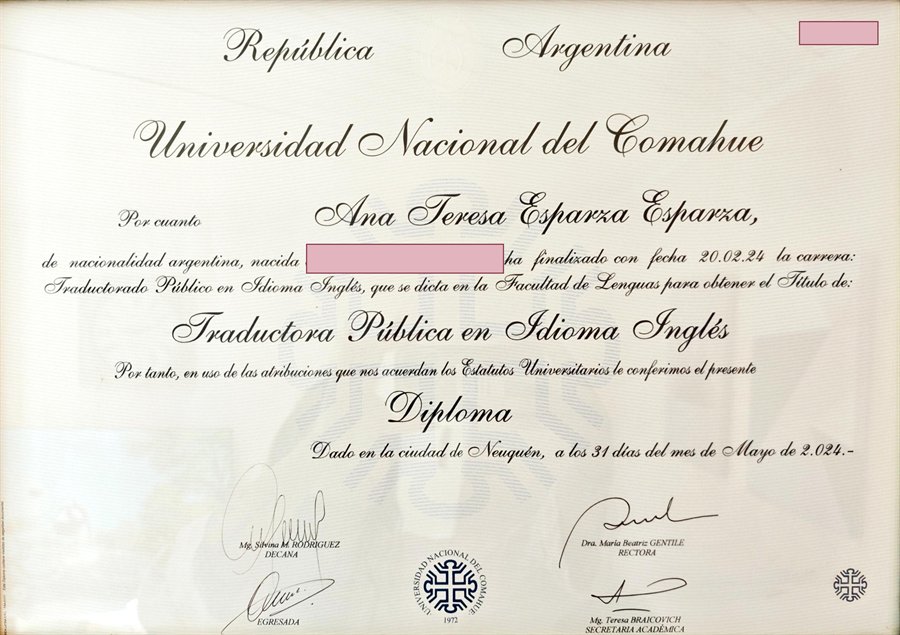
The date of birth and the diploma serial number are covered in the image. They are personal details that are not needed to evidence the degree.
Online quote calculator
Choose the type of document and the length, and the calculator works out the fee using the Association's current schedule. At the end you get the breakdown ready to send me on WhatsApp.